Why Stripe Freezes Accounts (and How to Avoid Losing Your Money)
Learn why Stripe freezes accounts, what triggers payment holds, and how to reduce the risk. Discover alternatives like crypto payments for more control.

Crypto payments are often described as final, borderless and available 24/7. That is true at the blockchain level: once a valid transaction is confirmed, it cannot be reversed like a card payment or bank transfer.
But this does not mean every crypto payment is automatically successful from a business perspective.
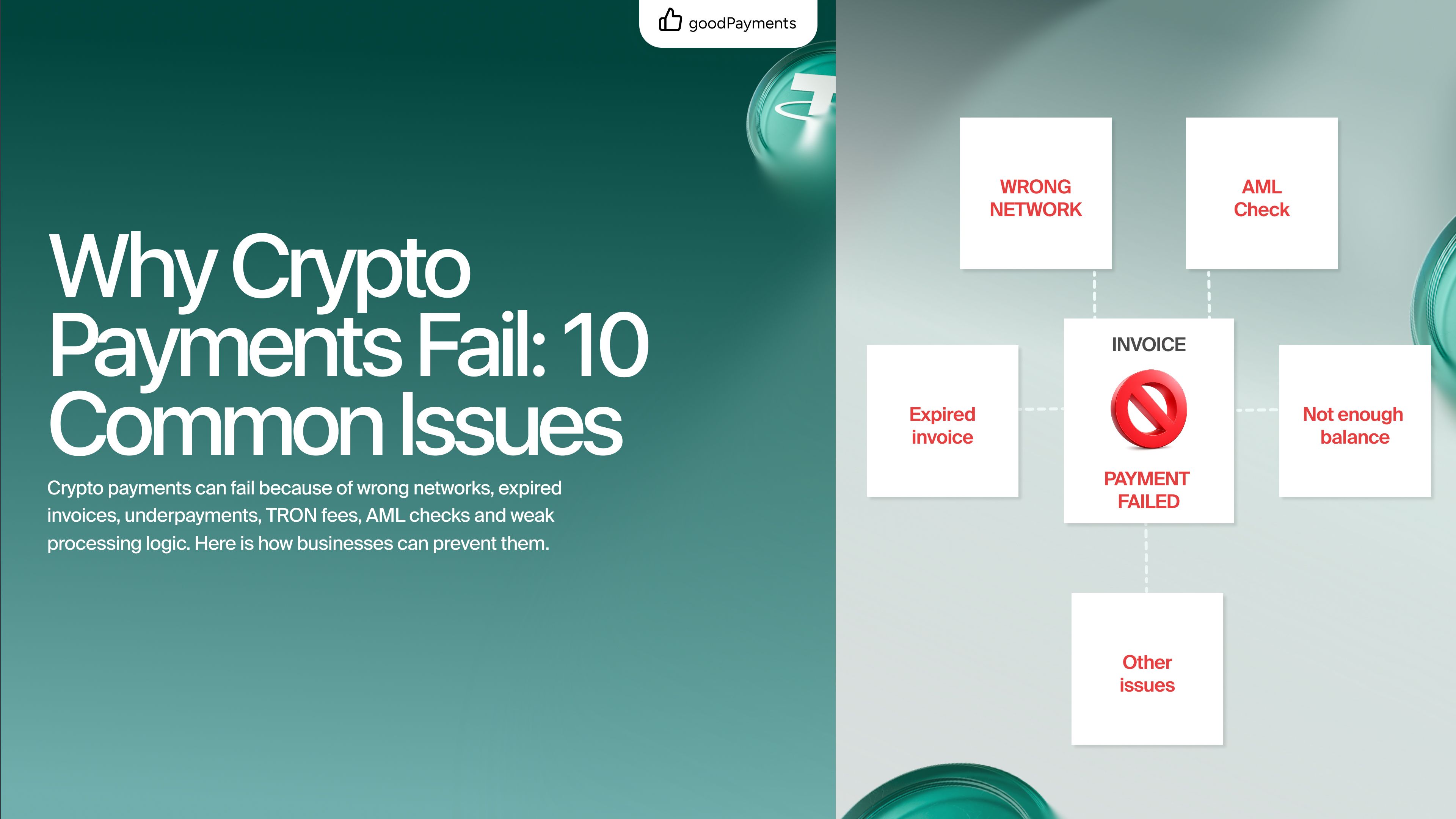
A customer can send funds and still fail to complete the order. A transaction can appear on-chain but remain unrecognized by the merchant system. A buyer can use the wrong network, send the wrong amount, pay after the invoice expires or trigger compliance checks. For the customer, this feels like “the payment failed.” For the business, it becomes a support ticket, a delayed order or a lost sale.
The important point is this: most failed crypto payments are not caused by blockchain failure. They are caused by gaps between blockchain logic, checkout UX, wallet behavior and payment processing rules.

1. The customer chooses the wrong blockchain network
This is one of the most frequent and painful mistakes in crypto payments.
A merchant may accept USDT TRC-20, but the customer sends USDT on Ethereum, BNB Chain, Polygon or another network. From the customer’s perspective, they sent “USDT.” From the payment system’s perspective, they sent funds to the wrong network.
This happens because many stablecoins exist across multiple blockchains. The ticker may look identical, but the technical route is different. A TRC-20 address and an ERC-20 transaction are not interchangeable.
For businesses, the fix starts with clear checkout design. The payment page should show the accepted asset and network together, for example: “USDT TRC-20,” not just “USDT.” The network should be repeated near the wallet address, QR code and payment instructions. It is also useful to add a short warning: “Send only USDT on TRON to this address.”
2. The invoice expires before the customer pays
Crypto invoices usually have a limited lifetime. This protects the merchant from stale orders, price changes, duplicated payments and reconciliation problems.
But customers do not always pay immediately. They may open the invoice, switch to a wallet, check their balance, buy additional TRX for network fees, ask a colleague for approval or simply get distracted. By the time the transaction is sent, the invoice may no longer be valid.
The blockchain transaction can still be successful, but the merchant system may no longer match it to the order automatically.
To reduce this risk, businesses should show a visible countdown timer, explain what happens after expiration and provide a simple way to generate a new payment request. For higher-value B2B payments, longer invoice windows may be more appropriate than short consumer-style timers.
3. The customer sends less than the required amount
Underpayment is another common reason a crypto payment is not credited automatically.
This can happen when the customer manually types the amount, sends from an exchange that deducts withdrawal fees, or misunderstands whether the network fee is paid separately. In some cases, the customer tries to round the amount or sends only the product price without including the exact invoice amount.
Even a small difference can create a reconciliation problem. If the invoice expects 100 USDT and receives 99.5 USDT, the system needs a rule: mark it as failed, mark it as partially paid, request the remaining amount or escalate it to manual review.
The best prevention is to make the exact amount easy to copy, encode it into the QR code where possible and avoid unnecessary decimals. Merchants should also define internal rules for small underpayments before they happen.
4. The customer sends more than the required amount
Overpayment sounds less harmful than underpayment, but it still creates operational issues.
A customer may send too much because they copy the wrong number, add extra funds to “cover fees,” or pay the same invoice twice. The order may be fulfilled, but the business now needs to decide how to handle the extra amount.
Should the excess be refunded? Should it be credited to the customer balance? Who pays the network fee for the refund? What happens if the refund address is risky or belongs to an exchange?
These questions should not be solved manually every time. Businesses need a clear overpayment policy and a payment system that detects the difference between expected and received amounts.
5. The transaction is broadcast but not confirmed yet
A crypto transaction is not final at the moment the customer clicks “send.” It must be broadcast, included in a block and confirmed according to the rules of the network.
On TRON, a transaction is considered confirmed when the block containing it is confirmed by the network’s Super Representative mechanism. TRON documentation explains that transactions returned through solidity APIs are confirmed, while regular wallet APIs may show transactions that are already on-chain but not necessarily final.
For merchants, this distinction matters. Crediting an order too early increases risk. Waiting too long creates customer anxiety.
A good checkout should show the payment state clearly: waiting for payment, detected, confirming, paid or failed. This is much better than leaving the customer with a static screen and no feedback.
6. The customer does not have enough TRX for network fees
For USDT TRC-20 payments, the customer usually needs TRX to pay network costs if they do not have enough TRON resources such as Energy and Bandwidth.
TRON transactions consume Bandwidth, and smart contract interactions also consume Energy. If the account does not have enough resources, TRX is burned to cover the fee.
This creates a common checkout problem: the customer has enough USDT but cannot send it because the wallet lacks TRX.
The payment page should warn users before they reach this point. A simple note like “You need TRX in your wallet to send USDT TRC-20” can prevent many failed attempts. For businesses with many crypto-native customers, this may seem obvious. For mainstream users, it is not.
7. The customer sends an unsupported token
Sometimes the customer sends the right network but the wrong asset.
For example, a merchant expects USDT TRC-20, but the customer sends TRX or another TRC-20 token to the same address. The transaction exists, but it does not match the invoice.
This happens when wallets display multiple tokens together or when customers assume any TRON-based asset is acceptable. It can also happen in B2B payments when the payer uses an internal treasury process and selects the wrong token.
The payment interface should make the accepted token unmistakable. Businesses should also avoid presenting too many payment options at once unless the checkout can clearly separate them.
8. Wallets and exchanges process withdrawals differently
Not all crypto payments come directly from self-custody wallets. Many customers pay from exchanges, custodial wallets or business treasury platforms.
These services may batch withdrawals, delay outgoing transactions, deduct fees from the sent amount, use internal risk checks or send from a different address than the one the customer expects. As a result, the merchant may see a transaction that does not perfectly match the checkout assumptions.
This is why relying only on a customer-declared transaction hash or sender address can be fragile. The payment processor should monitor the receiving address, amount, asset, network and confirmation status directly.
9. AML and compliance checks flag the transaction
Crypto payments are not outside compliance. Public blockchains make transactions traceable, and stablecoin issuers can restrict assets linked to sanctions, fraud or other illicit activity.
Tether has publicly stated that it cooperates with law enforcement agencies and can freeze assets connected to unlawful conduct or sanctioned actors. In April 2026, Tether announced that it supported the freeze of $344 million in USDT across two addresses in coordination with U.S. authorities.
For businesses, this means AML risk is not theoretical. A payment may arrive from a wallet with suspicious exposure, or funds may later become problematic from a compliance perspective.
The solution is not to reject crypto payments entirely. The solution is to build risk controls into the payment flow: wallet screening, transaction monitoring, internal risk thresholds and clear escalation rules.
10. The merchant-side payment logic is too fragile
Sometimes the blockchain, customer and wallet all work correctly — but the merchant system fails.
This can happen when the integration depends on unstable callbacks, does not handle delayed confirmations, treats every mismatch as a failure, lacks retry logic or does not reconcile payments after temporary API issues.
A reliable crypto payment setup should not depend on one event firing perfectly at one moment. It should be able to detect payments, update statuses, retry notifications and reconcile transactions after delays.
This is especially important for SaaS platforms, online services, exchanges and merchants with automated fulfillment. A failed webhook should not automatically become a lost payment.
The biggest improvement usually comes from treating crypto checkout as a product flow, not just a wallet address on a page.
Businesses should make the asset and network obvious, show the exact amount, use QR codes, explain fee requirements, display real-time payment status and define rules for underpayments, overpayments and expired invoices.
They should also monitor payments at the blockchain level instead of relying on customer screenshots. Screenshots are useful for support, but they are not a payment confirmation mechanism.
Finally, businesses should think about operational edge cases before launch. What happens if a customer pays late? What if they send 99.9 instead of 100 USDT? What if the payment is detected after the order is cancelled? What if AML risk is elevated?
Clear rules reduce support load and prevent inconsistent decisions.

goodPayments is a non-custodial crypto processing solution for businesses that want to accept TRX and USDT TRC-20 payments without giving up control of funds.
Instead of treating crypto checkout as a manual wallet transfer, businesses can use payment links, API integration, notifications and additional AML tools to make the payment flow easier to manage. Funds are received directly by the business, while the payment infrastructure helps track invoices, statuses and transaction events.
This does not make crypto payments magically error-free. No payment method is error-free. But it reduces the number of avoidable failures caused by unclear checkout instructions, missing statuses, manual reconciliation and weak processing logic.

Crypto payments fail for different reasons than card payments or bank transfers.
The problem is rarely that “the blockchain is broken.” More often, the customer used the wrong network, paid too late, sent the wrong amount, lacked TRX for fees, used an exchange with delayed withdrawals or triggered compliance checks.
For businesses, the lesson is simple: accepting crypto is not only about adding a wallet address. It requires a checkout flow, transaction monitoring, clear payment rules and reliable processing infrastructure.
The companies that solve these details will not just accept crypto. They will accept it with fewer lost payments, fewer support tickets and a better customer experience.
Learn why Stripe freezes accounts, what triggers payment holds, and how to reduce the risk. Discover alternatives like crypto payments for more control.
Learn how TRC20 payments work and why businesses use USDT on TRON. Step-by-step guide with setup, benefits, and best practices.
Want to start accepting USDT payments but don’t know where to begin? This step-by-step guide shows how to set up crypto payments quickly, avoid common mistakes, and keep full control of your funds.