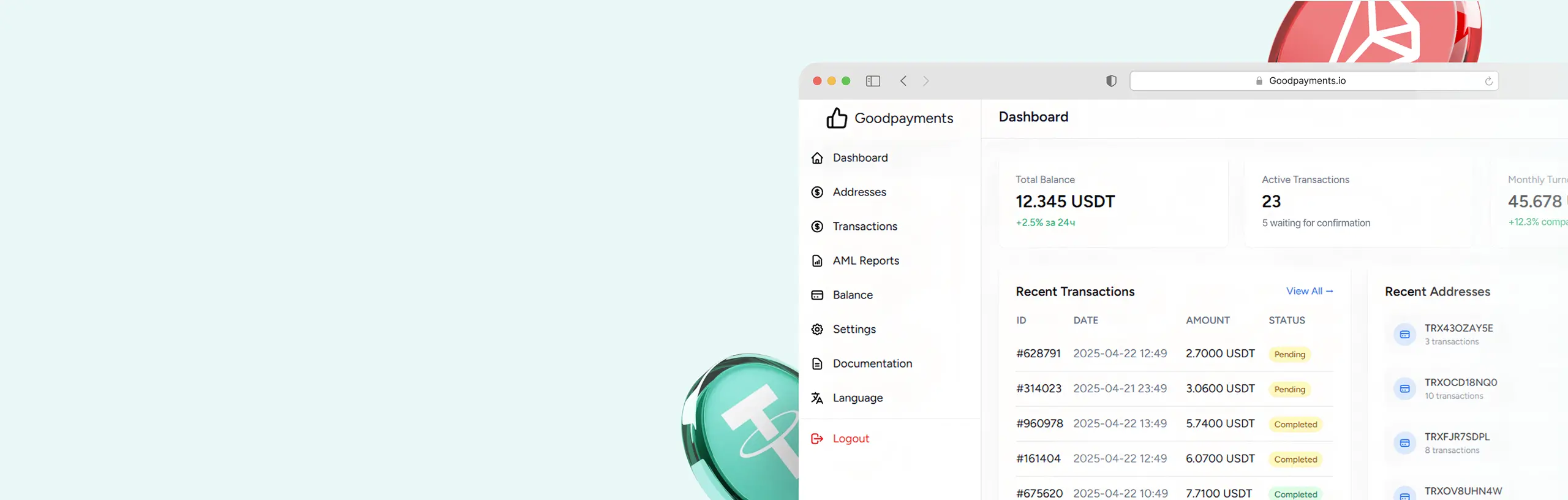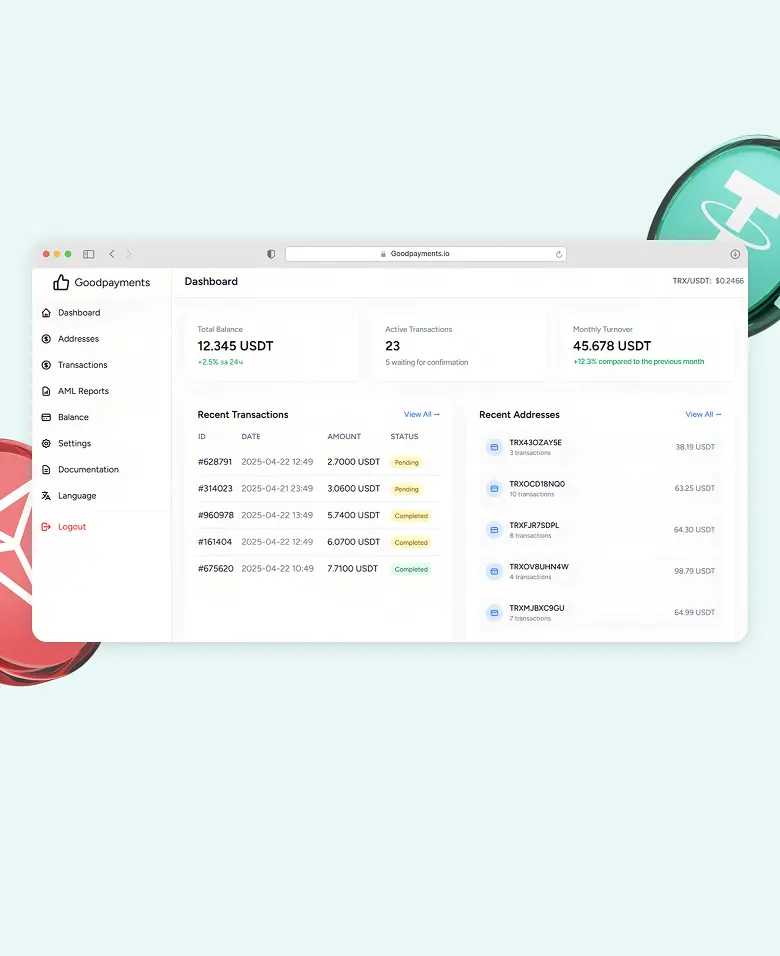
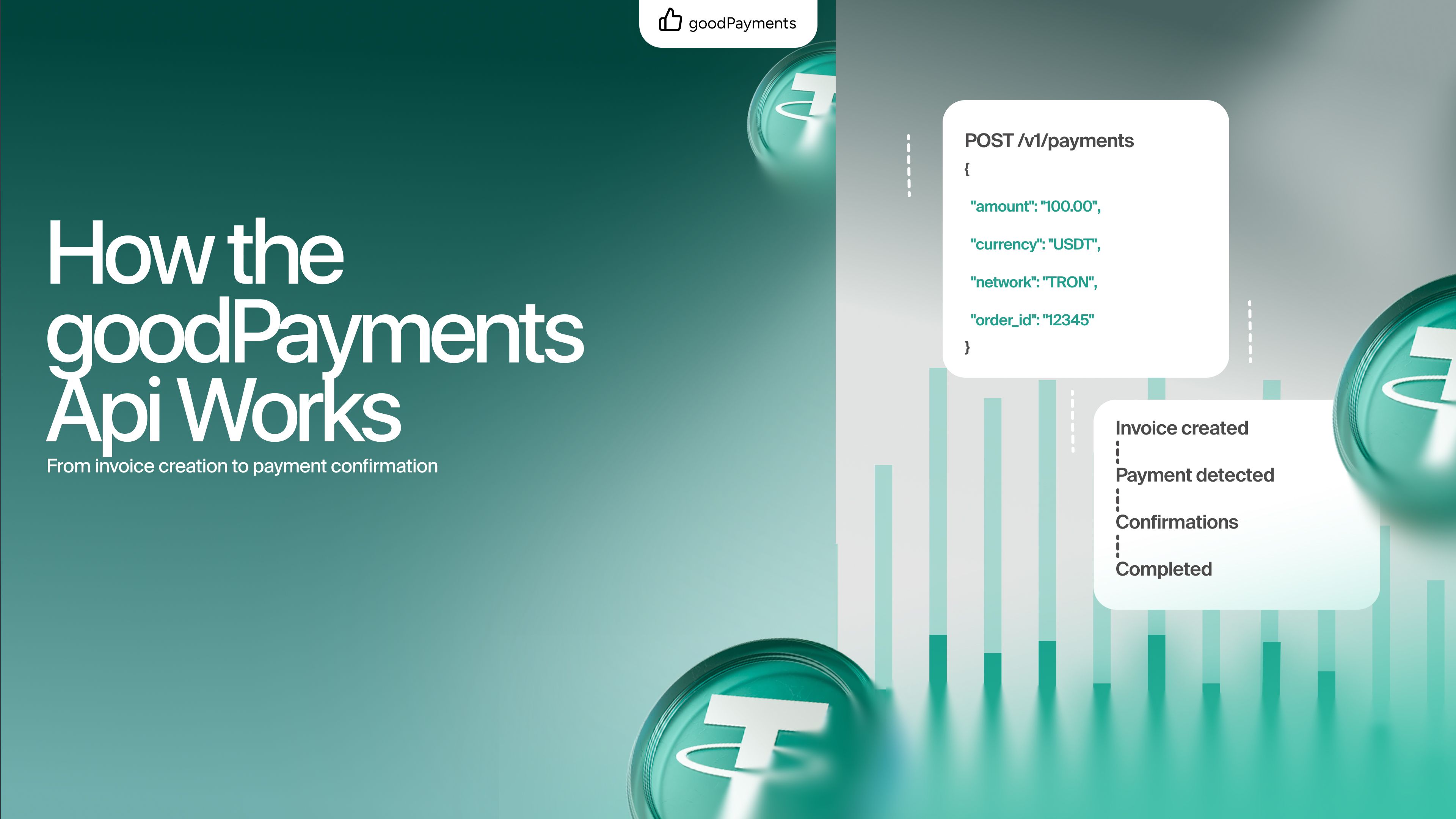
How the goodPayments Crypto Payment API Works: From Invoice Creation to Payment Confirmation
Learn how the goodPayments API handles TRX and USDT TRC-20 payments, from invoice creation and transaction tracking to order fulfilment and reconciliation.


Adding crypto payments to your website is not only about choosing a payment provider.
It is also about choosing the right integration method.
Some businesses need to start accepting payments as quickly as possible. Others need a fully automated checkout flow connected to orders, invoices, user balances, or internal dashboards.
That is why the choice between payment links and API integration matters.
Both options can help you accept crypto payments, but they solve different business needs.
Payment links are about speed and simplicity.
API integration is about automation, control, and scale.
Understanding the difference helps you avoid two common mistakes: overbuilding too early or staying manual for too long.
Payment links are one of the simplest ways to accept crypto payments.
A business creates a payment request, shares the link with a customer, and the customer completes the payment through that link.
There is no need to build a custom checkout from scratch. You can use payment links for invoices, direct sales, one-time services, private deals, or early product testing.
This makes payment links useful for businesses that want to start fast without spending time on development.
For example, payment links can work well for:
The main advantage is speed. You can start accepting payments before building a full technical integration.
API integration is a more advanced way to connect crypto payments to your website or platform.
Instead of creating payment requests manually, your system can generate them automatically. This allows payments to become part of your product flow.
For example, when a customer places an order, your website can automatically create a crypto payment request, display payment details, track the status, and update the order after confirmation.
API integration is useful when payments are not occasional, but part of your daily business operations.
This method is better suited for:
API integration requires more setup, but it gives your business more control over the payment experience.
The easiest way to understand the difference is this:
Payment links are manual but fast.
API integration is automated but requires setup.
Payment links and API integration solve different problems.
Neither option is “better” by default. The right choice depends on your business stage.
If you are testing demand or processing a small number of payments, payment links may be enough.
If payments are part of your product logic, API integration is usually the better option.
Payment links are a good choice when speed matters more than automation.
They are especially useful when you do not want to involve developers yet or when your payment process is still simple.
You should consider payment links if:
Payment links are also useful for businesses that sell services instead of products.
For example, if you run an agency, consulting service, private community, or B2B offer, you may not need a complex checkout immediately. A payment link can be enough to start accepting crypto payments.
The main benefit is that payment links reduce the barrier to entry.
You do not need to redesign your website or build a complex payment flow. You can start simple and move faster.
API integration becomes important when payments need to connect directly with your product.
If your website has orders, users, balances, subscriptions, or automated access logic, manual payment links may create too much operational work.
You should consider API integration if:
For example, an eCommerce website needs to know when an order has been paid.
A marketplace needs to connect payments to sellers, buyers, and internal balances.
An iGaming platform needs payments to connect with user accounts and deposit logic.
In these cases, API integration is not just a technical upgrade. It becomes part of the business infrastructure.
Many businesses do not need to start with API integration immediately.
A practical approach is to start with payment links and move to API when payment volume grows.
This is useful because it lets you test:
Once the flow proves useful, API integration becomes a natural next step.
This approach helps businesses avoid unnecessary development work before they know how crypto payments will be used in practice.
Start simple.
Validate demand.
Automate when the volume justifies it.

The best integration method depends on three things: volume, automation, and control.
If your business only accepts a few payments per week, payment links are usually enough.
If your business processes payments every day, API integration will likely save time and reduce manual work.
Ask yourself:
How often do customers pay?
If payments are rare or irregular, payment links can work well.
If payments happen constantly, API integration is better.
Do payments need to update automatically?
If a manager can manually check payments, payment links may be enough.
If your system needs to update orders or accounts automatically, API integration is the stronger option.
Do you need a custom checkout experience?
If a simple payment page is enough, use payment links.
If you need full control over the payment journey, API integration makes more sense.
Is your business ready for development work?
Payment links require less technical effort.
API integration needs development resources, but gives more long-term flexibility.
Overbuilding too early
Some businesses start with a complex API integration before they have enough payment volume.
This can waste development time and slow down launch.
If you are still testing crypto payments, payment links may be a better first step.
Staying manual for too long
The opposite mistake is staying with manual payment links after the business has already scaled.
If your team spends too much time creating links, checking payments, and updating orders manually, it is time to consider API integration.
Ignoring user experience
Crypto payments need to be clear.
Customers should understand:
Whether you use payment links or API integration, the payment experience should be simple and easy to follow.
Not planning for scale
A payment setup that works for 10 payments per week may not work for 1,000 payments per week.
Choose an integration path that can grow with your business.

goodPayments is built for businesses that want flexibility when accepting crypto payments.
Some businesses need a fast and simple start. Others need a more automated integration.
That is why goodPayments supports both approaches:
This gives businesses a practical path from simple crypto payments to a more scalable payment infrastructure.
You can start with payment links when you need speed, then move to API integration when automation becomes important.
The goal is not to force every business into the same setup.
The goal is to give businesses the right payment flow for their current stage.
Use payment links if you want:
Use API integration if you need:
For many businesses, the best strategy is not choosing one forever.
It is starting with the option that fits now and moving to a more advanced setup when the business grows.

Payment links and API integration both help businesses accept crypto payments, but they are designed for different stages.
Payment links are the fastest way to start.
API integration is the better choice for automation and scale.
If your business is just testing crypto payments, start simple.
If payments are already part of your core product flow, API integration gives you more control and reduces manual work.
With goodPayments, businesses can accept USDT TRC-20 and TRX using the method that fits them best: payment links for quick setup or API integration for a more automated checkout experience.
Learn how the goodPayments API handles TRX and USDT TRC-20 payments, from invoice creation and transaction tracking to order fulfilment and reconciliation.
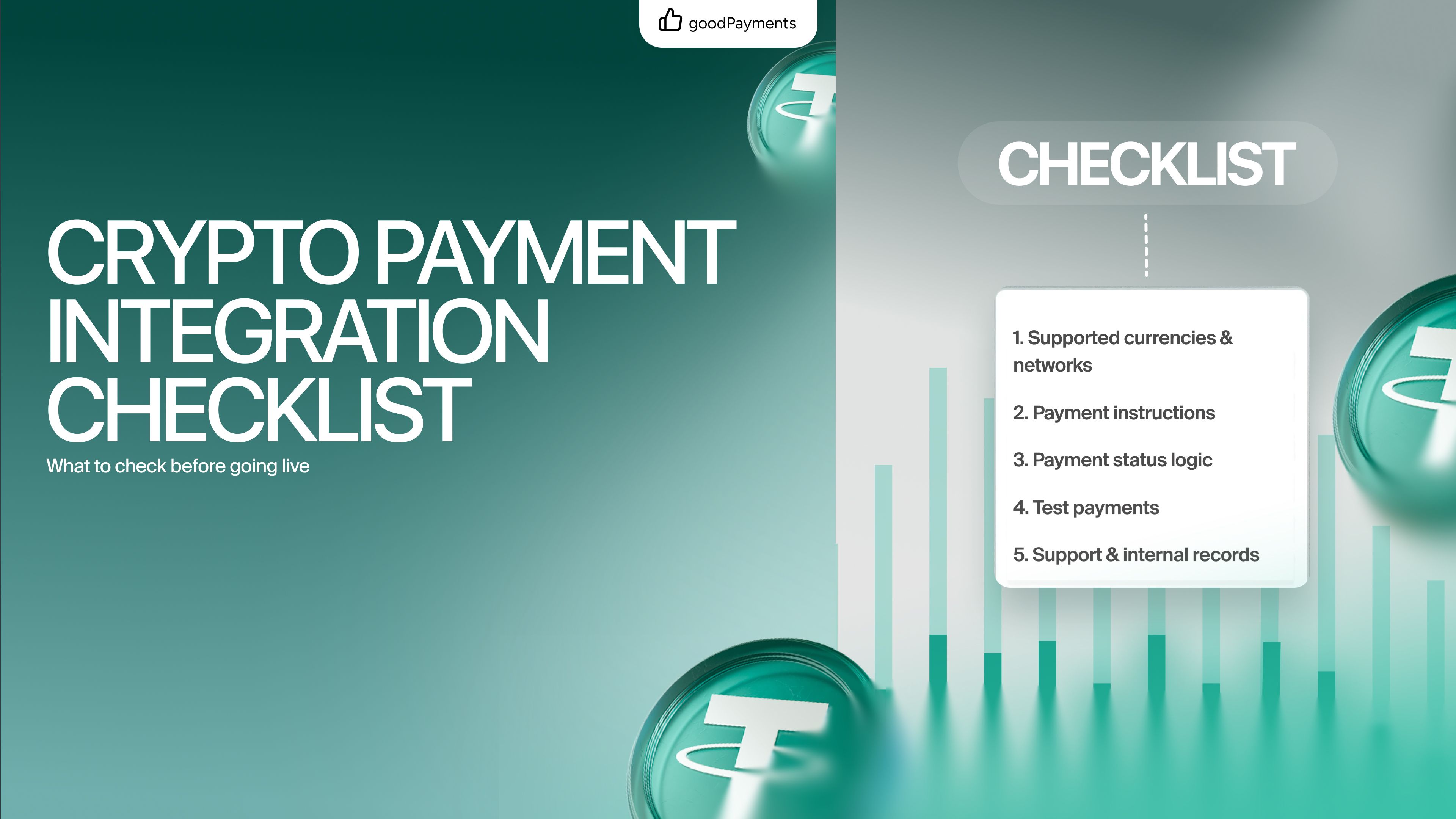
A practical checklist for businesses integrating crypto payments. Learn what to check before going live with USDT TRC-20 and TRX payments using goodPayments.
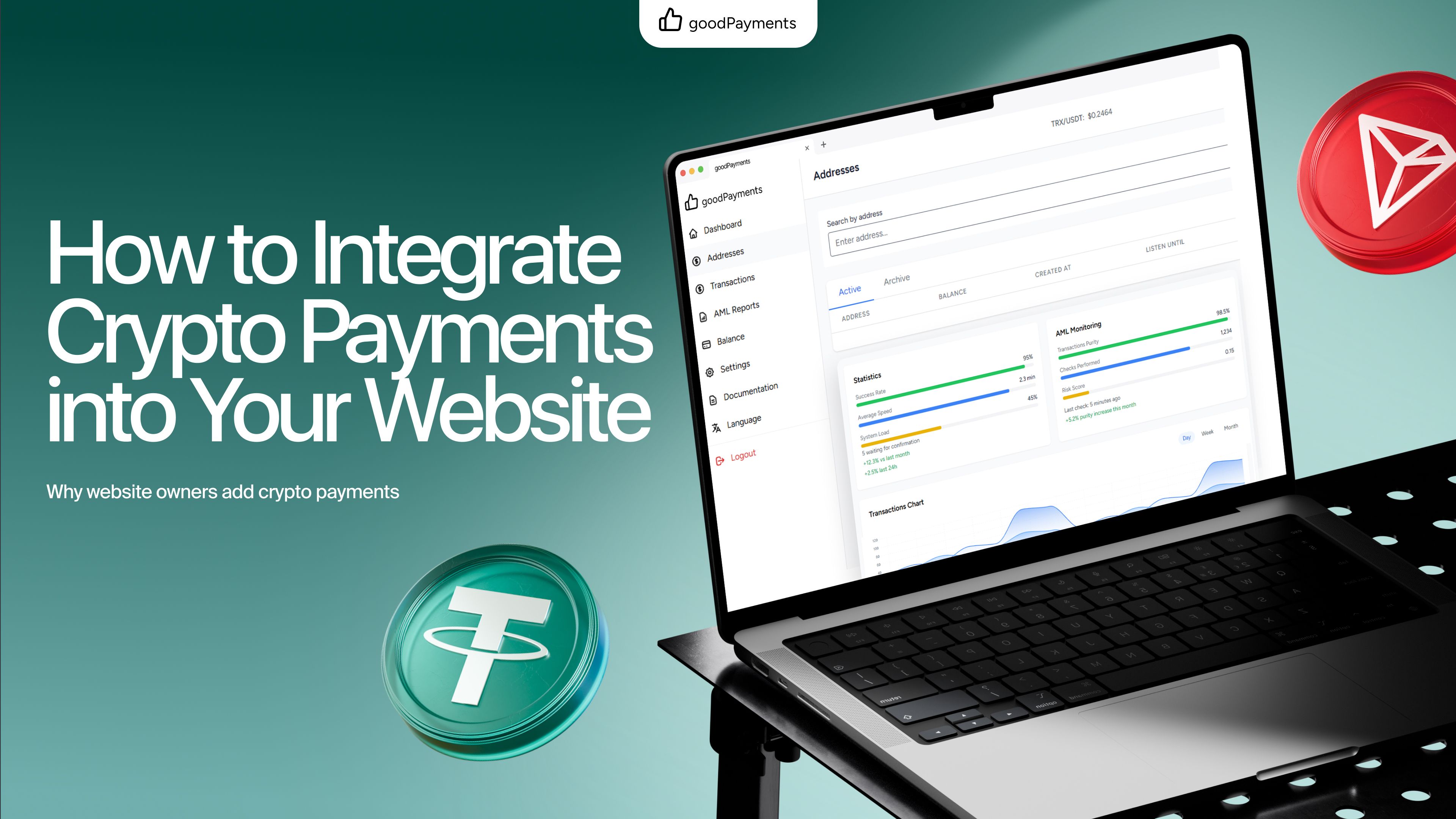
Learn how to integrate crypto payments into your website, choose between payment links and API integration, and start accepting USDT TRC-20 with goodPayments.