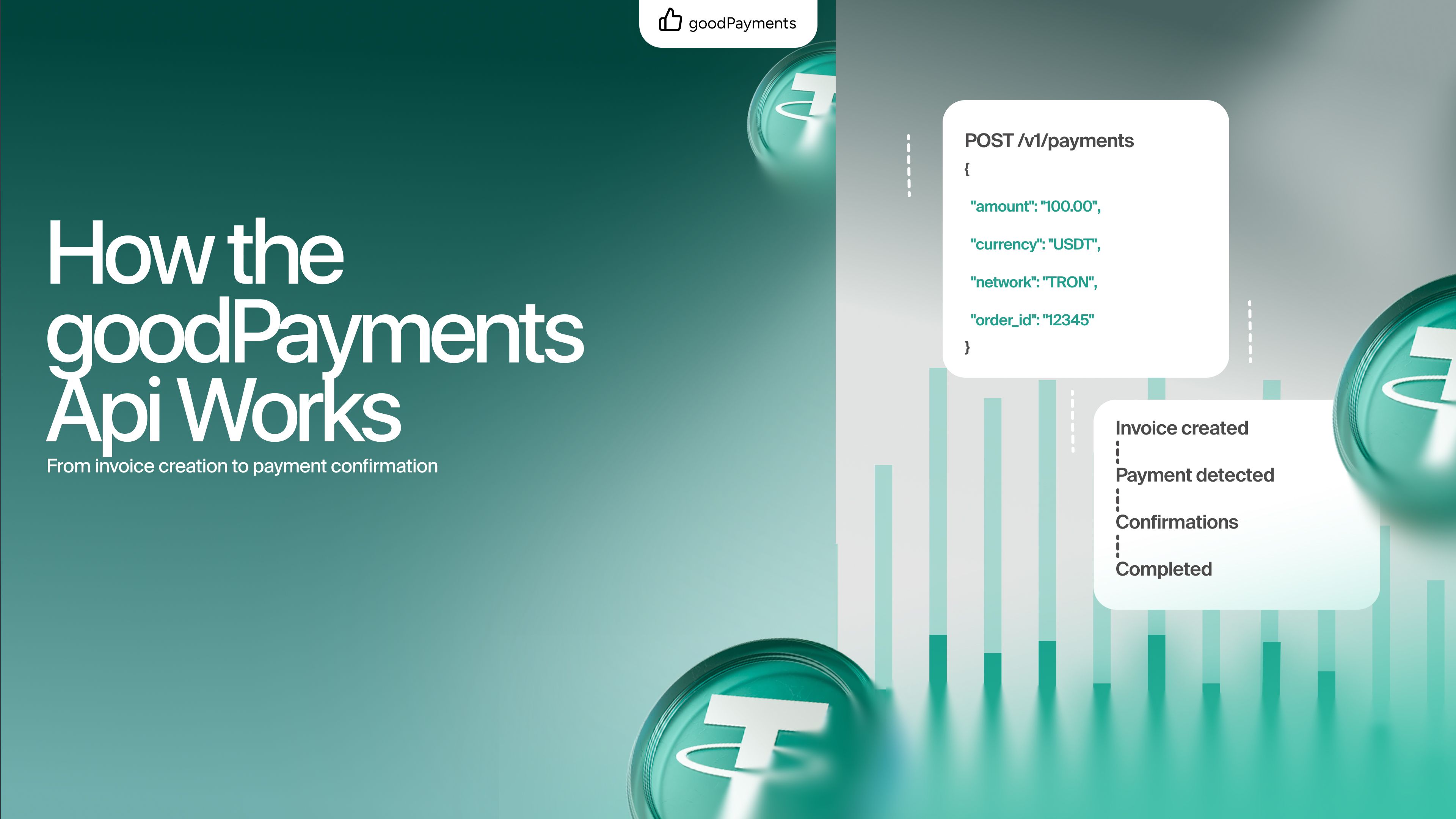
How the goodPayments Crypto Payment API Works: From Invoice Creation to Payment Confirmation
Learn how the goodPayments API handles TRX and USDT TRC-20 payments, from invoice creation and transaction tracking to order fulfilment and reconciliation.

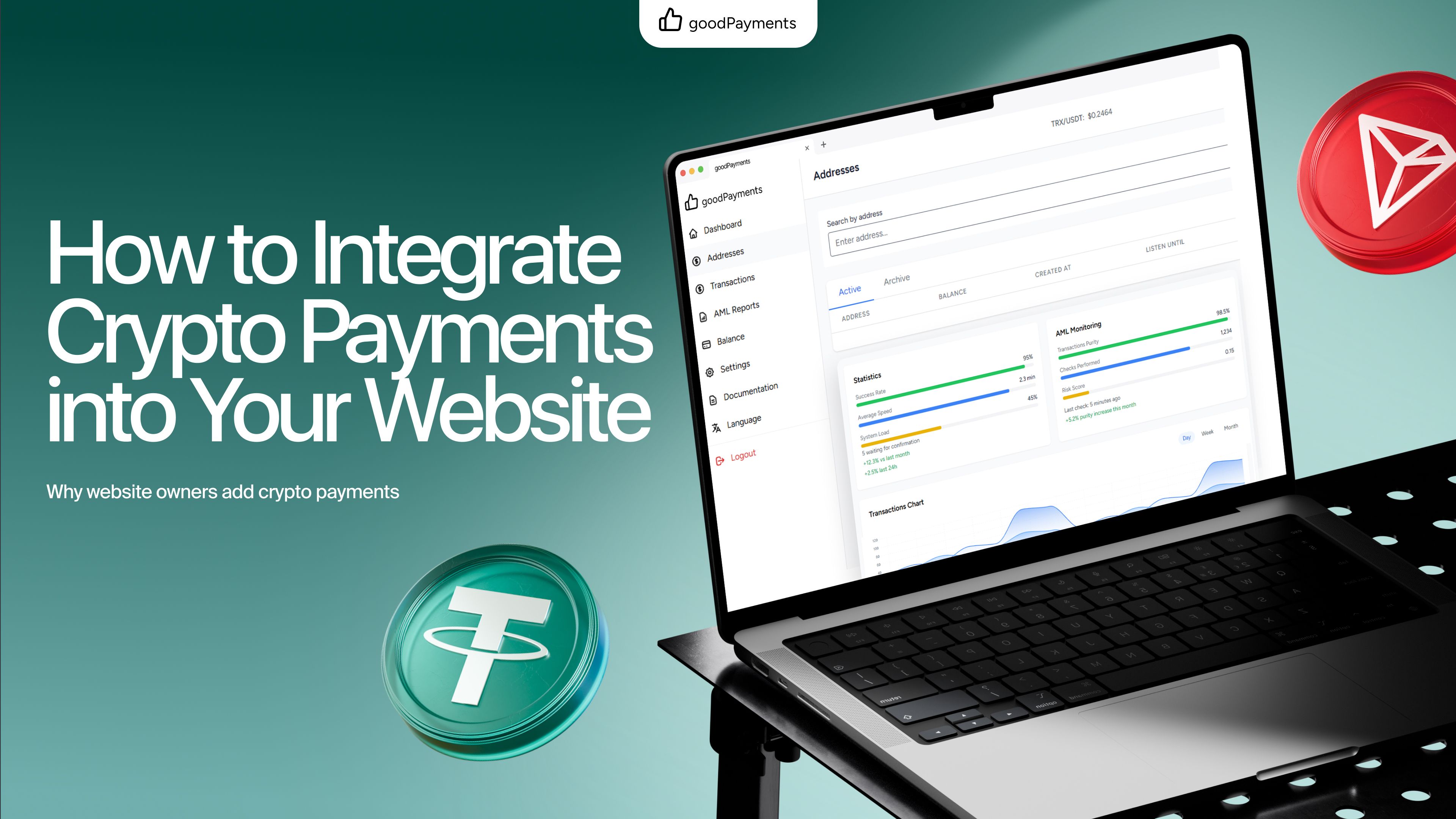
More online businesses are adding crypto payments because traditional payment systems are not always flexible enough.
Card payments, bank transfers, and classic payment processors can come with high fees, long settlement times, chargebacks, regional restrictions, and complex onboarding. For businesses working with global users, these problems become even more noticeable.
Crypto payments offer a different approach.
Instead of relying on banks or card networks, businesses can accept payments through blockchain networks. This allows them to receive funds faster, serve customers globally, and reduce dependency on traditional financial infrastructure.
For many websites, the goal is simple: make payments easier, faster, and more accessible.

Crypto payment integration means adding a payment flow to your website that allows customers to pay with cryptocurrency.
In practice, this can be as simple as adding a payment link or as advanced as connecting a full API checkout flow.
A typical crypto payment flow looks like this:
With goodPayments, businesses can accept USDT TRC-20 and TRX payments while keeping the process simple and direct.
The key point is that crypto integration does not always require a complex technical setup. The right method depends on how your website works and how much control you need over the payment experience.
There are two common ways to add crypto payments to a website: payment links and API integration.
Payment Links
Payment links are the fastest way to start accepting crypto payments.
You create a payment request, share the link with a customer, and the customer completes the payment through the generated flow.
This option is useful for:
Payment links are simple because they do not require deep technical work. They are ideal when you want to start fast and validate demand before building a custom checkout.
API Integration
API integration gives your website or platform more control over the payment process.
Instead of manually creating payment links, your system can generate payment requests automatically, track payment statuses, and connect crypto payments directly to your internal logic.
API integration is better for:
This method requires more setup, but it creates a smoother and more scalable payment experience.
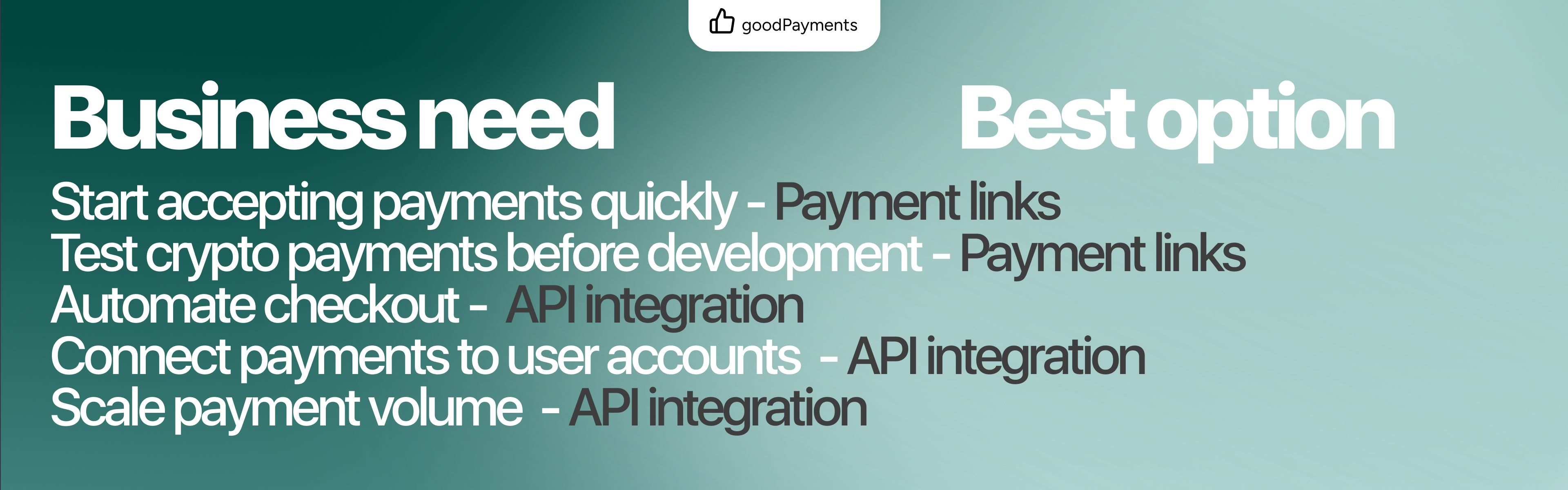
The best option depends on your business stage.
If you are just starting, payment links are usually enough. They allow you to accept crypto payments quickly without spending time on development.
If your website already has users, orders, invoices, subscriptions, or internal dashboards, API integration is usually the better long-term choice.
Payment links are about speed.
API integration is about control and scale.
For many businesses, the best path is to start with payment links and move to API integration once the payment flow becomes a core part of the product.
A simple way to decide:
A good crypto payment flow should be simple for the customer and reliable for the business.
The customer should clearly understand:
For USDT payments, network clarity is especially important. USDT exists on multiple networks, and USDT TRC-20 is not the same as USDT ERC-20 or BEP-20.
If your website accepts USDT TRC-20, the checkout should make that clear.
A clean payment flow reduces user mistakes, support requests, and failed payments.
Before launching crypto payments on your website, test the full flow from the user’s perspective.
Do not only check whether the integration technically works. Check whether the payment experience is clear.
Before going live, make sure:
This is especially important because crypto transactions are irreversible. A confusing checkout can lead to wrong-network transfers, incorrect amounts, or unnecessary support issues.
A good integration should prevent mistakes before they happen.
Making the Checkout Too Complicated
Crypto users want speed, but they also need clarity.
If the checkout screen has too much information, users may hesitate. If it has too little information, users may make mistakes.
The best flow is simple: currency, network, amount, address, status.
Not Explaining the Network
One of the biggest mistakes is showing “USDT” without clearly showing the network.
USDT TRC-20 must be labeled correctly so customers know exactly what to send.
Ignoring Payment Status
After a customer sends funds, they need to understand what is happening.
Your website should show a clear payment status: waiting, processing, confirmed, or failed.
Choosing the Wrong Integration Method
Some businesses overbuild too early. Others stay manual for too long.
If you only process a few payments per week, payment links may be enough. If payments are part of your product flow, API integration is the better option.
goodPayments is designed for businesses that want to accept crypto payments without unnecessary complexity.
It supports USDT TRC-20 and TRX payments, giving businesses access to fast and practical crypto payment rails.
The main advantages are:
This makes goodPayments useful for both simple and more advanced payment flows.
A business can start with payment links, then move toward API integration when it needs more automation and control.
Crypto payments are especially useful if your business works with global customers, crypto-native users, or industries where traditional payments create friction.
You should consider adding crypto payments if:
Crypto payments do not need to replace all existing methods immediately. For many businesses, they work best as an additional payment option.
This gives customers more flexibility while giving the business a faster and more direct payment channel.
Integrating crypto payments into your website is no longer a complex technical project.
With the right setup, you can start simple with payment links or build a more automated payment flow through API integration.
The key is choosing an integration method that matches your current business needs.
For fast setup, payment links are enough.
For scale, automation, and full control, API integration is the stronger option.
With goodPayments, businesses can start accepting USDT TRC-20 and TRX payments through a simple, flexible payment flow built for modern online payments.
Start accepting crypto payments on your website
Add USDT TRC-20 and TRX payments with goodPayments. Use payment links for fast setup or API integration for a fully automated checkout flow.
Start with goodPayments:
Learn how the goodPayments API handles TRX and USDT TRC-20 payments, from invoice creation and transaction tracking to order fulfilment and reconciliation.
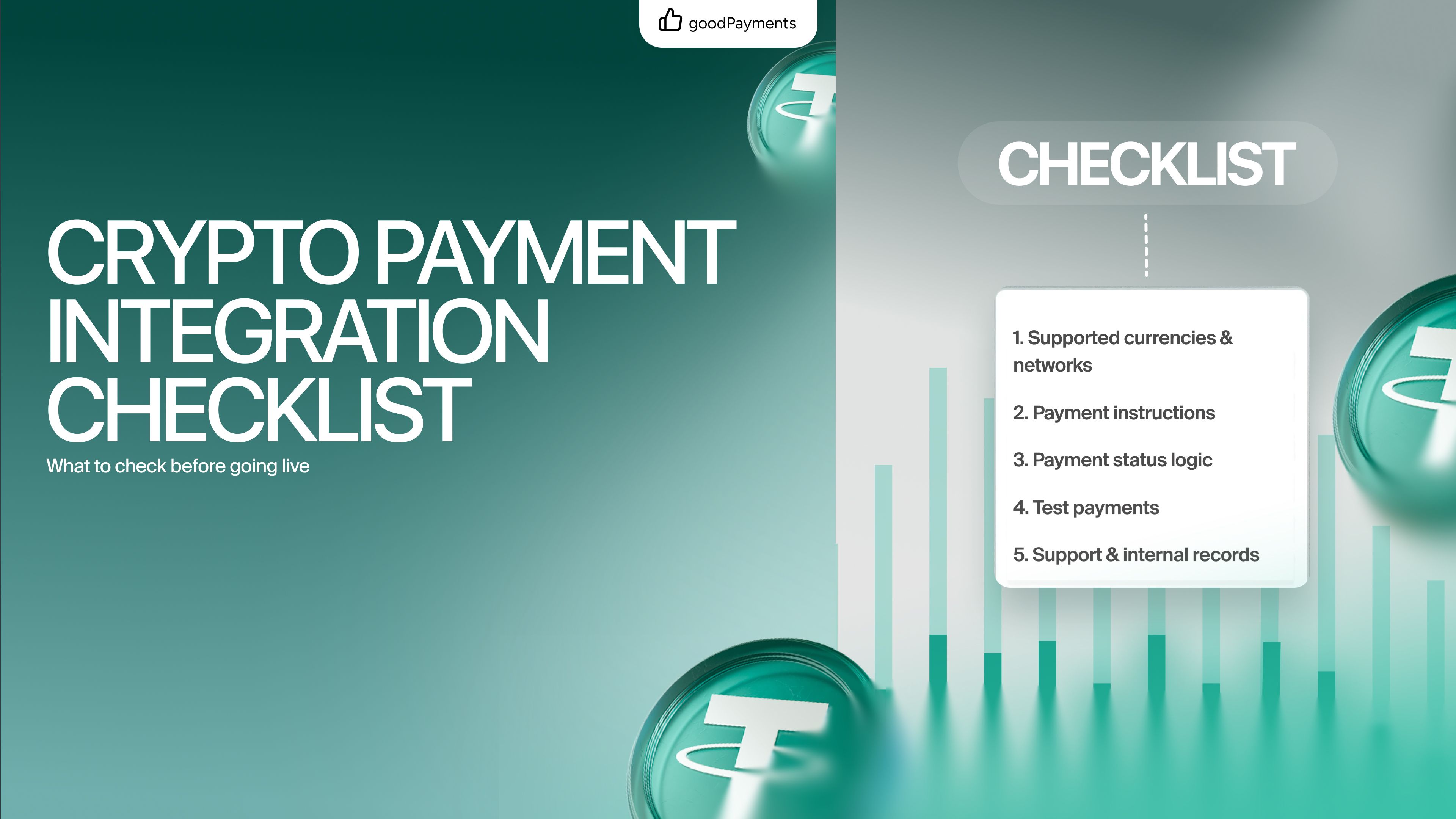
A practical checklist for businesses integrating crypto payments. Learn what to check before going live with USDT TRC-20 and TRX payments using goodPayments.
Compare payment links and API integration for crypto payments. Learn which option fits your business and how goodPayments helps you accept USDT TRC-20 and TRX.