Fixed fee vs percentage-based crypto payment processing: Which model Is better for businesses?

David Roshels
3 min read
Fixed fee vs percentage-based crypto payment processing: Which model Is better for businesses?Fixed fee vs percentage-based crypto payment processing: Which model Is better for businesses?
Why payment fees matter more than they seem

Why payment fees matter more than they seem

Payment processing fees may look small at first.

A 1% or 2% fee does not always feel like a serious cost when a business is just starting. But as transaction volume grows, percentage-based fees can turn into one of the biggest hidden expenses in the payment flow.

For online businesses, every payment fee directly affects margin.

  • If your business processes $10,000 per month, a 2% fee means $200 in payment costs.
  • If your business processes $100,000 per month, the same 2% fee becomes $2,000.

At $1,000,000 in monthly volume, that fee grows to $20,000.

The more your business earns, the more you pay.

That is why the fee model matters. Not only the fee amount, but the way the fee is calculated.

In crypto payment processing, businesses usually face two common pricing models: percentage-based fees and fixed fees.

Understanding the difference can help you choose a payment setup that protects your margins as you scale.

What is percentage-based payment processing?

Percentage-based payment processing means the provider charges a percentage of every transaction.

For example, if the fee is 2%, the provider takes 2% from each payment processed through the platform.

This model is common in traditional payments and many crypto payment solutions.

At low volume, it may seem simple and acceptable. But the problem is that the cost grows together with your revenue.

  • If a customer pays $100, a 2% fee is $2.
  • If a customer pays $1,000, the same 2% fee becomes $20.
  • If a customer pays $10,000, the fee becomes $200.

The provider is doing the same basic payment processing work, but your cost increases just because the transaction amount is higher.

For businesses with high average checks or large payment volume, this can become expensive very quickly.

What is fixed-fee payment processing?

Fixed-fee payment processing means the business pays a flat fee per transaction instead of a percentage of the payment amount.

The cost does not grow just because the transaction amount is larger.

This model is especially useful for businesses that process high-value payments or want predictable payment costs.

For example, with a fixed-fee model, a business can understand the cost of each transaction in advance. This makes financial planning easier and helps avoid margin erosion as volume grows.

The logic is simple:

  • percentage-based fees scale with your revenue.
  • fixed fees scale with the number of transactions.

For many businesses, especially those with larger payment amounts, fixed fees can be much more efficient.

Fixed fee vs percentage fee: The key difference

The main difference is how the payment cost grows.

With percentage-based pricing, your cost increases as the transaction value increases.

With fixed-fee pricing, your cost stays predictable per transaction.

This is why two businesses with the same number of transactions can pay completely different fees under a percentage-based model.

Imagine two companies each process 1,000 payments per month.

One company has an average payment of $20.

Another company has an average payment of $500.

With a percentage-based fee, the second company pays much more, even though the operational payment flow may be similar.

That is the core problem for high-value businesses.

Percentage-based fees punish growth in transaction size.

Fixed fees make payment costs easier to control.

Why percentage-based fees can hurt scaling businesses

Why percentage-based fees can hurt scaling businesses

Percentage-based fees become painful when a business starts growing.

At the beginning, they may feel convenient because the cost seems proportional. But over time, the business starts giving away more revenue simply because its volume increases.

This creates several problems.

Margins Become Harder to Protect

If your business operates with tight margins, every percent matters.

A 2% payment fee can be manageable in some industries. But for high-volume businesses, even small percentages can represent thousands of dollars per month.

Costs Become Less Predictable

When your payment volume changes, your fee expenses change with it.

This makes forecasting harder, especially for businesses with seasonal spikes, large orders, or variable transaction sizes.

Larger Payments Become More Expensive

A percentage model charges more for larger transactions.

This can be a problem for businesses with high average order values, B2B payments, iGaming deposits, marketplace settlements, or high-ticket digital services.

Growth Creates Higher Payment Costs

The more your business grows, the more you pay to the payment processor.

This can feel inefficient when the payment infrastructure itself does not become more complex with every larger transaction.


When fixed fees make more sense

Fixed-fee payment processing becomes especially attractive when the transaction amount is high or when the business wants predictable costs.

It can be a better fit for:

  • high-ticket products or services
  • iGaming and betting platforms
  • B2B payments
  • crypto-native businesses
  • marketplaces
  • SaaS products with larger invoices
  • businesses with high monthly payment volume

The bigger the transaction amount, the more important the fee structure becomes.

If your business processes many small payments, percentage fees may sometimes feel acceptable. But if your business processes larger payments, fixed fees can help protect margins.

The fixed-fee model gives businesses more control because payment costs are not tied directly to revenue.

Why this matters for crypto payments

Crypto payments already give businesses an alternative to traditional payment rails.

They can reduce dependency on banks, speed up settlement, and allow global payments without relying on card networks.

But not all crypto payment providers use the same pricing model.

Some platforms copy the traditional payment processor model and charge a percentage of every transaction.

This means the business may still face the same basic problem: the more it earns, the more it pays in processing fees.

A fixed-fee crypto payment model changes the economics.

Instead of giving away a percentage of every payment, the business pays a predictable transaction cost.

For businesses accepting USDT TRC-20 or TRX, this can make crypto payments more efficient and scalable.

Example: how fees change with transaction size

Let’s compare two simplified models.

A business receives a $1,000 payment.

With a 2% fee, the processing cost is $20.

If the same business receives a $10,000 payment, the cost becomes $200.

Now compare that to a fixed-fee model.

The payment amount changes, but the fee does not increase as a percentage of the transaction value.

This difference becomes more important at scale.

For businesses processing large transactions, the gap between percentage-based and fixed-fee pricing can become significant.

The question is not only “how much is the fee?”

The better question is: “Does this fee model become more expensive as my business grows?”

How goodPayments uses a fixed-fee model

How goodPayments uses a fixed-fee model

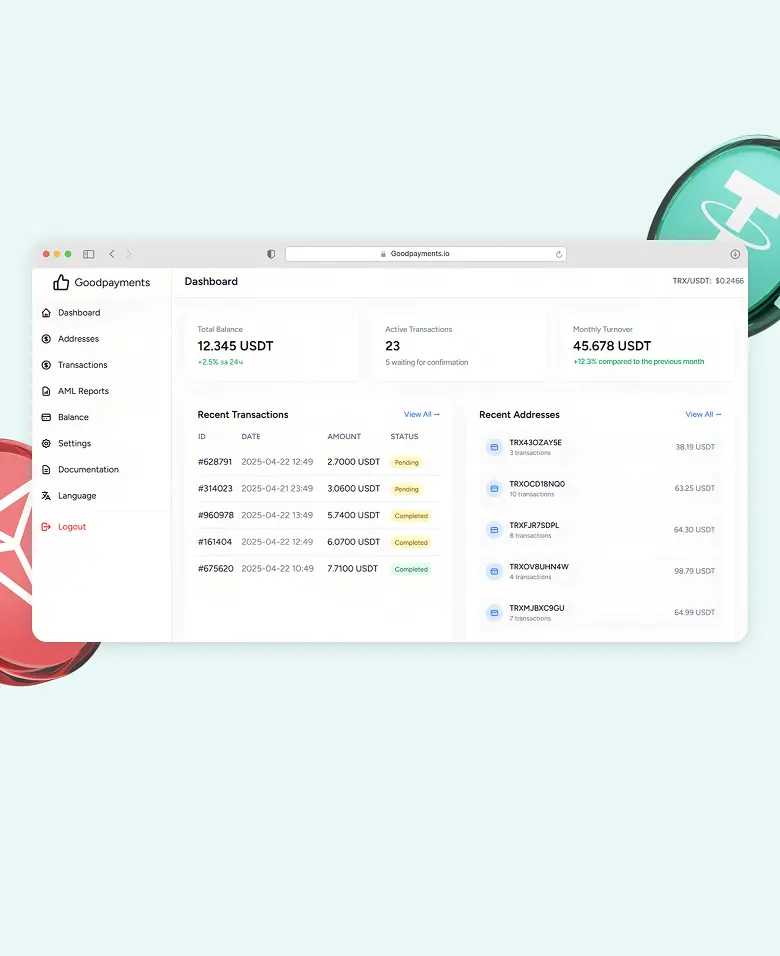
goodPayments is built around a different approach to crypto payment processing.

Instead of taking a percentage from every transaction, goodPayments uses a fixed-fee model.

This gives businesses a more predictable way to accept USDT TRC-20 and TRX payments.

The key advantages are:

  • no percentage fee from turnover
  • predictable transaction costs
  • better fit for high-volume businesses
  • useful for high average payment amounts
  • simple cost structure
  • non-custodial payment flow

This model is especially useful for businesses that do not want payment fees to grow automatically with revenue.

With goodPayments, the goal is simple: help businesses accept crypto payments while keeping more control over costs and funds.

Fixed fees and non-custodial payments

The fee model is only one part of the payment setup.

Another important factor is custody.

In a custodial payment system, the provider may hold funds before sending them to the business. In a non-custodial model, payments can go directly to the merchant’s wallet.

goodPayments is designed as a non-custodial solution, meaning businesses keep control over their funds instead of relying on the platform to hold them.

For many businesses, this combination is important:

  • fixed fees for predictable costs
  • non-custodial flow for direct control
  • USDT TRC-20 and TRX support for practical crypto payments

Together, these elements create a payment setup focused on efficiency and control.

How to choose the right fee model

There is no universal answer for every business, but the decision becomes easier when you look at your payment structure.

Ask yourself:

  • How many payments do we process per month?
  • What is our average transaction size?
  • How much are we paying in percentage-based fees now?
  • Will these costs grow as our volume increases?
  • Do we need more predictable payment expenses?
  • Do we want direct control over incoming funds?

If your business processes low-value transactions, the difference may be smaller.

But if your business has larger payments, high volume, or tight margins, the fee model can have a serious impact on profitability.

In that case, fixed-fee crypto payment processing may be the better long-term option.

Common mistakes businesses make

Looking only at the headline Fee

A provider may advertise a low percentage, but even a small percentage can become expensive at scale.

Always calculate the real monthly cost based on your expected volume.

Ignoring average transaction size

Fee models affect businesses differently depending on average payment amount.

A 2% fee on a $20 transaction is very different from a 2% fee on a $5,000 transaction.

Not thinking about growth

A fee model that works today may become expensive later.

If your business expects to grow, choose a payment setup that will still make sense at higher volume.

Treating crypto payments like card payments

Crypto payments do not need to copy traditional card processing economics.

If the goal is faster, more direct, and more efficient payments, the pricing model should reflect that.

Final thoughts

Final thoughts

The difference between fixed-fee and percentage-based payment processing may seem small at first, but it becomes important as your business grows.

Percentage-based fees increase together with your revenue.

Fixed fees give you more predictable payment costs.

For businesses with high transaction volume or larger payment amounts, this can make a major difference.

Crypto payments are already changing how businesses accept money online. But the real advantage comes when the payment model is also built for efficiency.

With goodPayments, businesses can accept USDT TRC-20 and TRX using a fixed-fee, non-custodial payment flow designed to help them keep more control over their revenue.

Related content

Ready to simplify your
payments?
Message our manager on Telegram
Send message